
Breadcrumbs
- You are here:
-
Home

-
Forum
-
DIscussions
-
Tech Help
-
Ercoupe/Forney Specific
- Generator
Generator
- John Herman
- Topic Author
- Offline
Less
More
- Posts: 8
17 Aug 2026 07:57 #1
by John Herman
Replied by John Herman on topic Generator
Thank You to all. We now have a fully operational 415C. We found that the regulator was not working properly with the generator we had , checked all the wireing and got a new regulator and we're good to go.
Thanks again for all your help
John
Thanks again for all your help
John
The following user(s) said Thank You: John Jones
Please Log in or Create an account to join the conversation.
- John Herman
- Topic Author
- Offline
Less
More
- Posts: 8
15 May 2026 12:08 #2
by John Herman
Replied by John Herman on topic Generator
Many thanks, We are still trying and will let you know the outcome.
Thanks Again, John
Thanks Again, John
Please Log in or Create an account to join the conversation.
- Brooks McNew
-

- Offline
Less
More
- Posts: 203
14 May 2026 14:02 - 14 May 2026 14:10 #3
by Brooks McNew
Replied by Brooks McNew on topic Generator
I hope it's not too hard to get to the bottom of it!Since you're still working, I'll add in a couple pieces of information just in case they're helpful.
1. If you have a bad voltage regulator (my plane did when I bought it) instead of putting in another antique Delco-Remy unit, I went with the solid-state electronic PMA replacement . It's lighter, has no moving parts, and basically does everything better, including a "soft start" to save wear on the generator, and it can automatically flash the field when needed.
The only downside is that although it mounts to the same holes in the same location, you need to buy mounting bolts that are about 1/4" shorter (or stack up a bunch of washers... ugly!) because the base flange is thinner. The original voltage regulator mounting bolts will "bottom out" their threads before they tighten down on the new unit.
2. If your master switch is faulty or intermittent, a new high-current switch is too expensive, and the old kinda-high-current switch is, I believe, only available in new OLD stock or used. I still don't trust them. The Alpha Aviation STC is $300 and comes with all the parts needed... it removes the high current from the switch - now the switch only carries 0.8 amps to activate the solenoid, and the solenoid does the "heavy lifting" of feeding many amps to the starter.
Compared to my previous drawing, the solenoid STC changes your wiring to this:
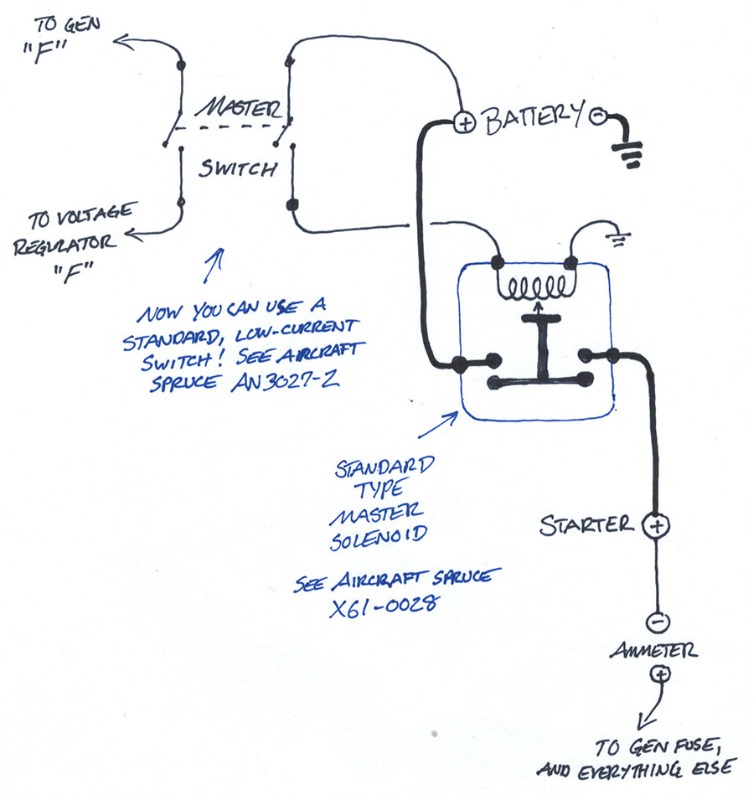
(There's also a voltage spike protection diode in the STC kit, I just didn't draw it)
1. If you have a bad voltage regulator (my plane did when I bought it) instead of putting in another antique Delco-Remy unit, I went with the solid-state electronic PMA replacement . It's lighter, has no moving parts, and basically does everything better, including a "soft start" to save wear on the generator, and it can automatically flash the field when needed.
The only downside is that although it mounts to the same holes in the same location, you need to buy mounting bolts that are about 1/4" shorter (or stack up a bunch of washers... ugly!) because the base flange is thinner. The original voltage regulator mounting bolts will "bottom out" their threads before they tighten down on the new unit.
2. If your master switch is faulty or intermittent, a new high-current switch is too expensive, and the old kinda-high-current switch is, I believe, only available in new OLD stock or used. I still don't trust them. The Alpha Aviation STC is $300 and comes with all the parts needed... it removes the high current from the switch - now the switch only carries 0.8 amps to activate the solenoid, and the solenoid does the "heavy lifting" of feeding many amps to the starter.
Compared to my previous drawing, the solenoid STC changes your wiring to this:
(There's also a voltage spike protection diode in the STC kit, I just didn't draw it)
Attachments:
Last edit: 14 May 2026 14:10 by Brooks McNew.
Please Log in or Create an account to join the conversation.
- John Herman
- Topic Author
- Offline
Less
More
- Posts: 8
14 May 2026 09:20 #4
by John Herman
Replied by John Herman on topic Generator
Still investigating. We are doing the annual right now and trying to determine exactly where the problem lies. Thanks for your assistance, I will keep you informed of our progress.
Please Log in or Create an account to join the conversation.
- Brooks McNew
-
- Offline
Less
More
- Posts: 203
13 May 2026 21:58 #5
by Brooks McNew
Replied by Brooks McNew on topic Generator
Any update? Curious about the source of this problem.
Please Log in or Create an account to join the conversation.
- John Herman
- Topic Author
- Offline
Less
More
- Posts: 8
04 May 2026 09:16 #6
by John Herman
Replied by John Herman on topic Generator
Thanks, We will give it a try!
Please Log in or Create an account to join the conversation.
Time to create page: 0.057 seconds